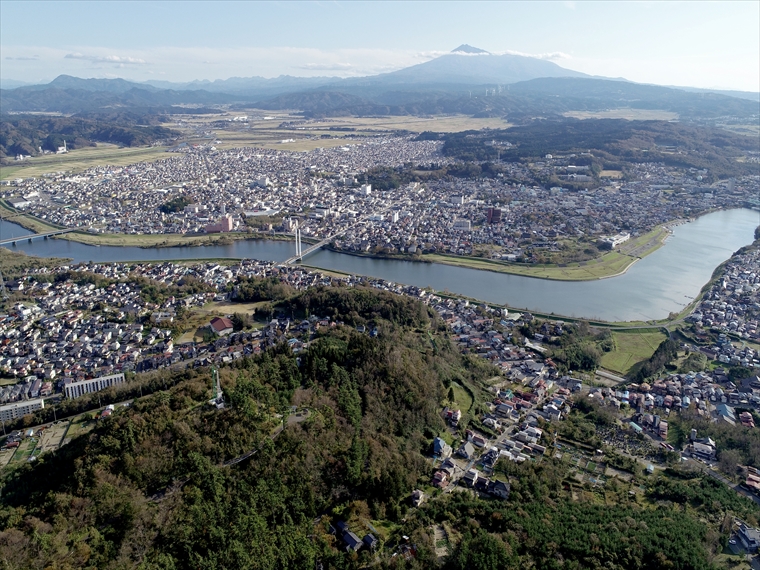
About 8 million years ago, when this area was part of a shallow sea, submarine volcanoes erupted and ash, pebbles (lapilli), and masses of volcanic rock accumulated here. These various-sized debris from volcanic activity hardened together to form a type of rock known as pyroclastic rock. The pyroclastic rock here is called Shinzan Andesite and has an estimated thickness of 200 m.
More than 100 thousand years ago, this area was uplfted from the sea to form a large mountain. Erosion then wore the mountain down, and the harder rocks remained as small hills 100–140 m high. These hills make up Shinzan Park.
In the forest of Japanese camellias (Camellia japonica), there is a cliff of Shinzan Andesite ranging 2–10 m high. Inside it there are also greyish rocks slightly larger than a human’s fist.
From Shinzan Park, you can enjoy a view of both Mt. Chōkai and the Sea of Japan.
Note: Shinzan Park and Shinzan Andesite are not related to Shinzan Peak, which is the youngest peak of Mt. Chōkai.
 Geopark Sites
 Search by Category